For a fragrance house sold in more than 120 countries, with over 1,500 retail points worldwide, and an impressive 650% year-over-year (YoY) growth, Nishane has one conspicuous gap in its global footprint: the United States.
“The US market was our weakest link,” Nishane co-founder and Creative Director Murat Katran told BeautyMatter. “It is strange to have a global brand without a strong footprint in the US, which I believe is the most important market.”
Now, the Istanbul-born fragrance house is playing catch-up.
On October 1, Nishane opened its first standalone US boutique on Elizabeth Street in New York’s Nolita neighborhood, in partnership with official US distributor The PCA Companies. The store is Nishane’s 16th mono-brand store globally and, more importantly, its first permanent space to build a direct relationship with American consumers, after previously being sold at Neiman Marcus, Bloomingdale's, and Luckyscent.
New York appears to be only the beginning. Katran confirmed to BeautyMatter that the company is already looking at a larger location in Los Angeles.
The Nolita store marks a major step up in Nishane’s US ambitions as the fragrance house accelerates its global expansion. Earlier this year, Nishane was named part of BeautyMatter’s 2026 FUTURE50 list, with projected full-year revenue between $150 million and $200 million. At the time, founders Katran and Mert Güzel said success over the next three to five years would mean expanding Nishane mono boutiques worldwide, describing physical retail as an increasingly important way to translate the storytelling behind fragrance into experience.
That expansion is now being backed by outside capital. After more than a decade as a self-funded business, Nishane secured its first major institutional investment through a strategic partnership with Netherlands-based Mada and Turkey’s Maxis Girişim in 2025, investing through Atlas Growth Capital/Atlas Growth Equity Fund.
The capital will support international expansion, product development, brand awareness, and the growth of Nishane’s luxury distribution network. Güzel and Katran retain majority ownership and control of the business, giving the founders additional resources to scale without handing over the creative direction that has defined the house.
The timing is significant. Nishane is no longer simply testing whether its fragrances can travel internationally; it is investing in the infrastructure needed to turn global distribution into a more recognizable global brand. Its New York boutique is one of the clearest manifestations of that shift. Nolita tests that thesis in one of fragrance’s most competitive markets.
Nishane’s path into the US has not been as straightforward as its expansion elsewhere. The brand has built an international following around high-concentration extrait de parfums, expansive storytelling, and fragrances including Hacivat, Ani, and Fan Your Flames. Its global ascent has led it to prestigious retailers, including Harrods, Galeries Lafayette, and Harvey Nichols.
America, however, lagged. Katran attributes some of that delay to previous distribution relationships that, in his view, didn't prioritize building Nishane the way the founders wanted. Contractual commitments meant the company could not immediately change course. “We lost time.”
Now working with PCA, Katran says Nishane sees an opportunity to reintroduce itself to the market effectively. “We are in the right hands,” he said. “Now, we just want to show that we are physically here.”
That physical presence is increasingly significant as niche fragrance itself becomes decidedly less niche. Independent, artistic fragrance houses that once relied on specialist perfumeries have increasingly moved into department stores, multibrand retailers, and their own branded environments.
Katran sees that evolution firsthand. “At Nishane, we can no longer talk about niche perfumes that are hard to find. We are everywhere,” he said. “At several department stores across the world, and many niche perfume stores, you can find Nishane.”
The challenge, then, is no longer simply availability. It is building enough brand recognition to reach consumers beyond fragrance’s already highly engaged inner circle.
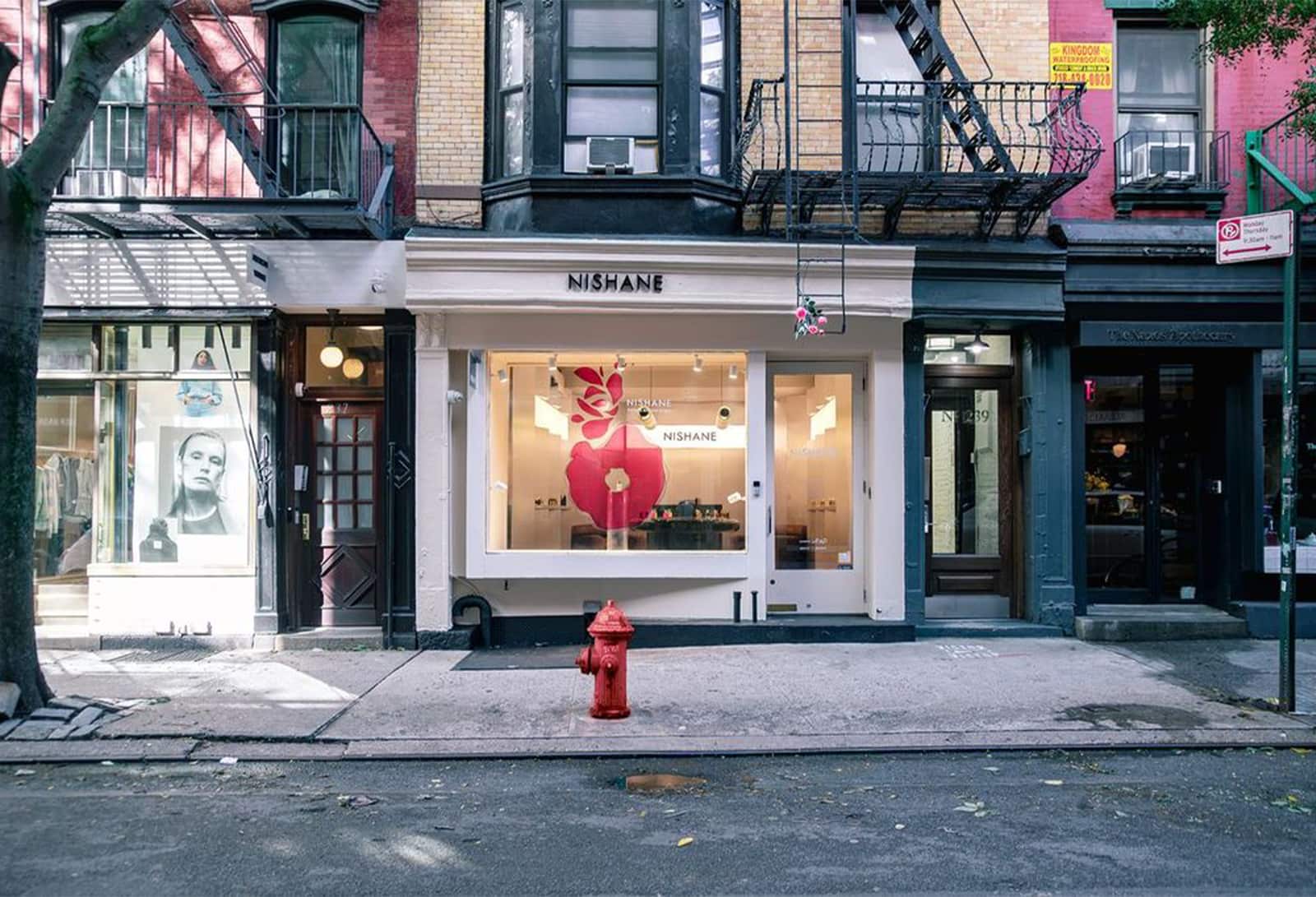
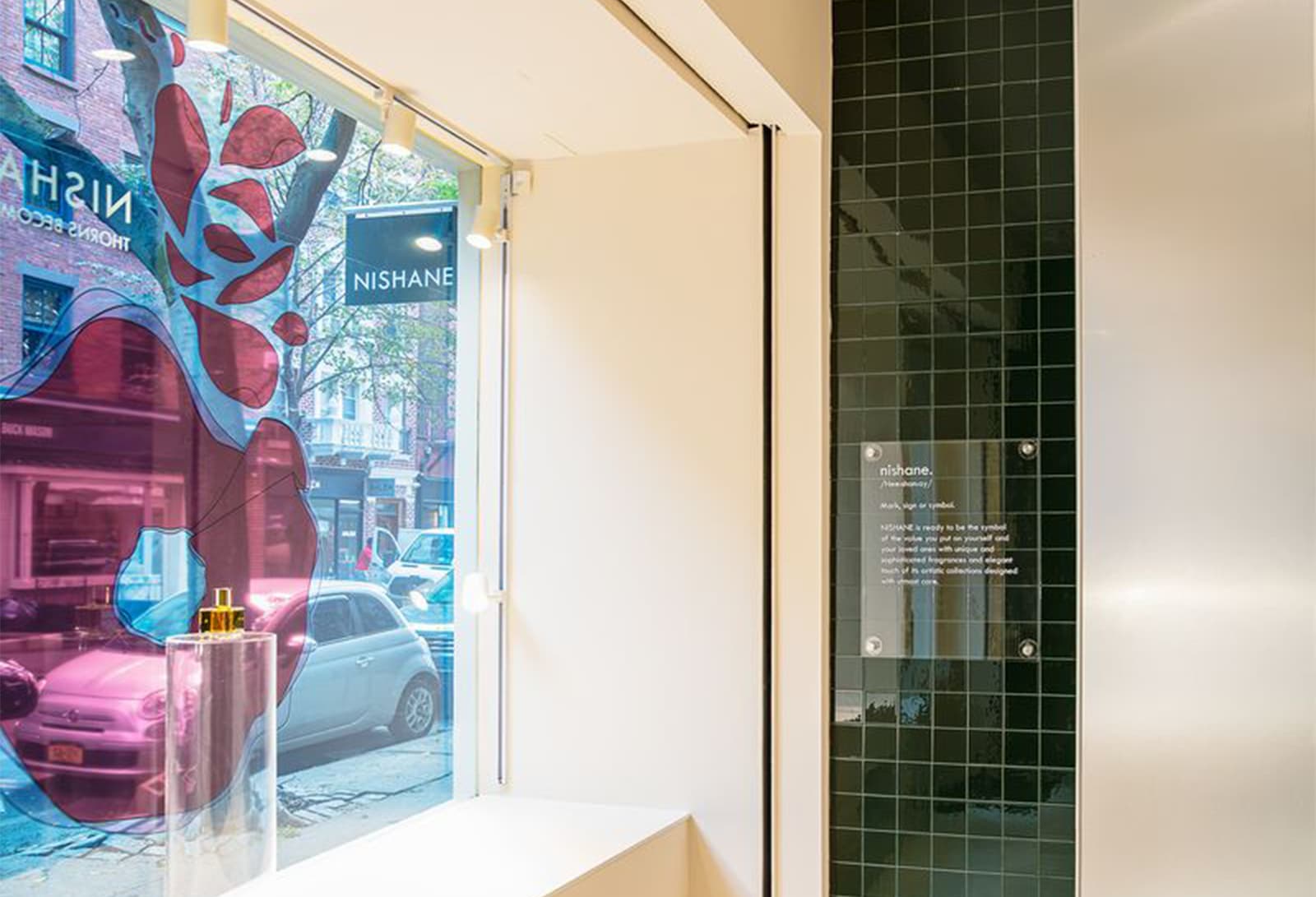
Nishane chose Elizabeth Street in Nolita for its reputation as a fragrance hub. For Katran, that positioning mirrors the brand itself. Nishane’s identity has long drawn on Istanbul’s position between East and West, using its Turkish roots as a starting point rather than a geographic limitation. BeautyMatter previously traced how Katran’s background in acting and Güzel’s experience in luxury hospitality shaped the brand’s early emphasis on narrative and experience.
Katran describes Nolita as similarly multicultural and artistic, making it a natural home for the brand.
The boutique’s design, led by an in-house team, leans into that intention. The boutique features mirrored metal, deep green accents, lounge seating, and a central fragrance-discovery table. Rather than building around a traditional fragrance counter, the space centers on guided discovery, encouraging visitors to take time to understand the inspiration and creative process behind individual scents.
For Nishane, this intentional layout matters. Katran and Güzel told BeautyMatter that the fragrance industry was underestimating “deep storytelling and experiential retail,” arguing that boutiques could build emotional connections that short-lived viral moments could not.
The New York store is intended to bring that thinking to life.
“Our main differentiation point is the strong stories that we really tell,” Katran said, adding that sales associates will be trained not simply to explain notes but to understand what customers are seeking and connect them to the narratives surrounding different fragrances.
The company is still developing specific in-store rituals and experiential programming ahead of opening, including guided scent discovery and access to Nishane’s creative team.
Of course, an immersive store still needs to work as a business. For all the attention paid to design, footfall, conversion, CRM capture, and average transaction value, Katran said Nishane watches one metric particularly closely across its global boutiques: whether people come back.
“Repeat visits are the most important thing we always chase in every store,” he said. “We just want our customers to feel like they’re home.”
For an already established fan base, the boutique creates a place for deeper engagement. But Nishane is equally interested in the consumer who might walk past the store without knowing Hacivat from Ani. “When people know about the brand, they are already in love,” Katran said. “But we have to also create new customers.”
That is where the economics of standalone retail become bigger than four-wall sales. A branded location offers Nishane control over the assortment, consumer experience, training, storytelling, and relationship-building in ways that a shelf in a multibrand environment cannot.
PCA will operate the location, but, according to Katran, it will do so in line with Nishane’s criteria and retail standards.
The fragrance house is also preparing to increase investment in marketing and communications around the market. “We really value and believe that the US market is the market that we should be known [in], just like we are known elsewhere.”
Nolita, therefore, should not be mistaken for the culmination of Nishane’s American expansion. Katran is careful not to call the store a flagship. Instead, he describes it as a base from which the company can finally interact directly with US consumers. Los Angeles could fulfill that role.
Meanwhile, Nishane is employing a similar strategy elsewhere. Katran said the company is relocating its Paris presence into a roughly 200-square-meter space that will become its flagship in the French capital. The moves suggest that the mono-brand strategy outlined by the founders at the beginning of 2026 is quickly moving from ambition to real estate.
For Nishane, that expansion also says something larger about where niche fragrance is heading. As once-insider houses grow into nine-figure global businesses, the next competitive frontier is increasingly about who can translate the cult following built through specialist retail and fragrance communities into a recognizable consumer brand without sanding away the eccentricity that made people care in the first place.
Nishane has already proved it can travel from Istanbul to more than 140 countries. Now comes the market it says it should have cracked much sooner. This time, Nishane is not leaving that relationship to somebody else.